Journal Prompt, Class 2 on Bacchae
Performance project: pp. 432-436, the cross-dressing scene.
- Dionysus, disguised as a human follower of Dionysus, helps Pentheus select an outfit to allow him to pass as a maenad, a female worshiper of Dionysus, that so Pentheus can spy on his mother and aunts while they worship the god.
How do you see this scene? What is Pentheus' state of mind, and how to get that across? What is Dionysus' attitude, and how to get that across?
Text Access
Euripides. 10 Plays. Trans. Paul Roche. New York: Signet Classic, 1998. (Available via bookstore.)
Background
Title
The title Bacchae ("BAH-kee"), or (in Greek) Bakkhai ("BAHK-high"), means something like "the women who cry io bakkhe," that is, bacchants: women who celebrate the god Dionysus with their ecstatic cries. Another word for such women (i.e., for bakkhai) is maenads, "women in the throes of madness/frenzy" — that is, women celebrating the god Dionysus with the kind of ecstatic abandon typically associated with the god.
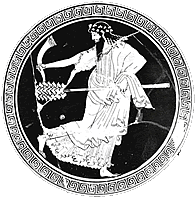
NOTE: Dionysus himself can similarly be called Bakkhos (or "Bacchus"). He can also be called Bromios ("Roarer"), Dithurambos ("Twice-Born"?), and Iakkhos, this last the name of the god when he is associated with the Eleusinian fertility mysteries.
Note also that, as in this play, the god can be pictured as worshiping himself, as yet another participant in his own festivities. In effect, worship of Dionysus IS WHAT DIONYSUS IS.
In our play, the Bakkhai of the title are Dionysus' female devotees, who form a thiasos, an association dedicated to the worship of the god. These women have been brought by the god from Asia (specifically, from Lydia, in modern Turkey) to Thebes. They will be joined by women from the town and palace of Thebes itself.
Situation
The god Dionysus is the child of Zeus by Semele, a mortal woman and princess of Thebes in Greece. (She is the daughter of Cadmus, founder of Thebes.) While pregnant with the divine child, Semele died, consumed by Zeus' lightning. (She had requested to behold Zeus' divinity in all its glory.) Zeus, however, rescuing the child from its incinerated mother's womb, sowed it into his thigh.
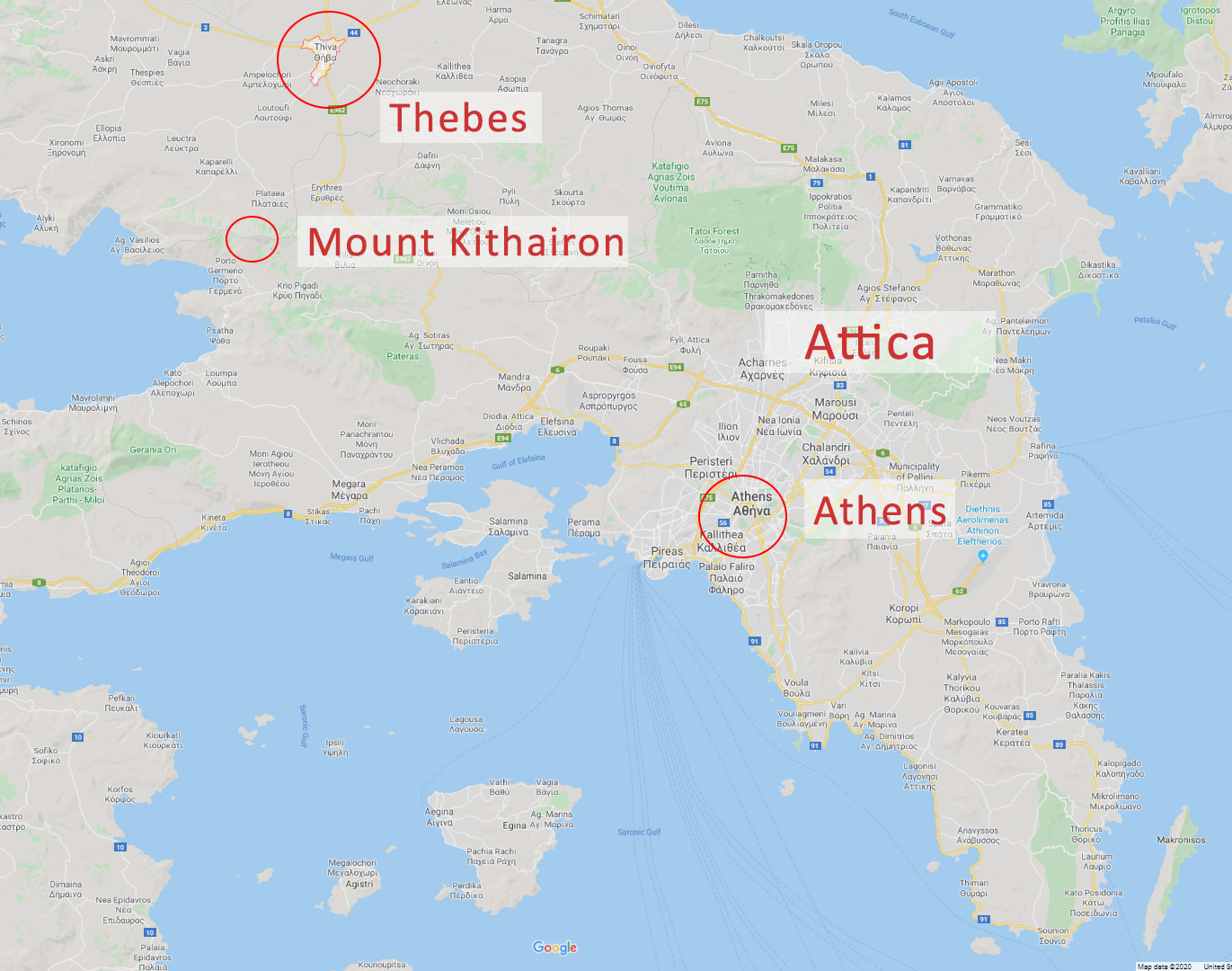
Once Dionysus emerges from this "second womb" of Zeus' thigh, he travels through Asia — regions encompassing Bactria (present-day Afghanistan), Persia and Media (Iran), Phrygia and Lydia (present-day Turkey), Arabia — on a successful mission to convert the people there to his worship. Dionysus is returning home now to Thebes, for it is his intention to introduce the cult of Dionysus — his cult — into Greece (aka "Hellas"), the land of his birth. He brings with him his thiasos of bacchants, his female band of worshipers.
But the sisters of Semele, the god's mother, together with Cadmus, the god's mortal grandfather, have dishonored Semele. Agave and Semele's other sisters claimed that Semele's pregnancy was not by a god, but by a human father, and that Semele lied. That was in effect to deny the god Dionysus his divinity — hubris! Like mother, like son: Pentheus, son of Agave and grandson of Cadmus (and thus cousin of Dionysus) likewise takes an anti-Dionysian position, as you shall see. In partial payback for the insult, Dionysus causes Pentheus, Agave, and the others to become unusually fanatical worshipers. of his.
This is, then, as already stated, a revenge play, only the injured party and avenger (and leading character) is a god.
Main Characters
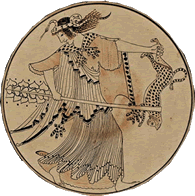
- Dionysus (aka Bromius, Bacchus), a god, son of Zeus and mortal Semele
- Pentheus, young king of Thebes, son of Agave, and cousin of Dionysus. His name can be taken to mean, "He who mourns," "He who wails." The play makes much of that connection
- Agave (ag-AH-vee), mother of Pentheus and sister of Semele, Autonoe, Ino
- Agave is mother of Pentheus
- Semele is mother of Dionysus
- Autonoe is mother of Acteon, who meets a tragic end similar to Pentheus' (see below)
- Ino, also a mother, tried to murder her stepchildren out of jealousy. Instead of killing them, she and her two sons died

- Cadmus, elderly founder of Thebes, father of Semele and Agave, grandfather of Dionysus and Pentheus
- Semele (SEH-me-lee), mother of Dionysus, incinerated when she asked to behold Zeus. Not a speaking character in the play (she's dead), but her name comes up often — see Agave, above
- Ino, see above
- Tiresias, aged Theban seer (we've seen him in Antigone)
- Chorus of Lydian bacchants, the thiasos of Dionysus. They are the "bacchae" of the title
- Soldier, a character like the Sentry in Antigone
- Herdsman who serves as a "messenger" character, that is, to report offstage action
- Another messenger character to report on Pentheus' encounter with the maenads, mother and aunts included, in the mountains
Setting
A few words on setting are in order. The city is Thebes, which later will be home to Oedipus. The audience sees the front of the palace of Cadmus; somewhere off to one side, perhaps not seen by the audience, will be the still smoking grave of Semele.
Offstage locales where important action happens are: the town of Thebes itself (audience right), and Mount Cithaeron/Kithairon, outside the city (audience left). On the slopes of Mount Cithaeron will take place the secret rituals of the Lydian bacchants joined by Theban maenads (again, "bacchant" and "maenad" being, more or less, two words for the same thing).
Further Study Questions
Of the surviving plays by any tragic (as opposed to comic) playwright, this is only one of two directly concerning the god Dionysus; the other is Cyclops (satyr play), also by Euripides.
- Do you detect possible cultic elements in this play?
- Is Dionysus for real? Does he earn your respect? Is he a con artist, a manipulative cult leader? Is he good or bad?
- What do you make of the cross-dressing in Bacchae? Of "special effects" like the destruction of the palace of Pentheus? Of the behavior of the Maenads? What Pentheus thinks the Maenads are up to?
- How do you like the ending? (Sparagmos, ritual dismemberment)
This is, among other things, a revenge play — in that respect it resembles various tragedies we'll be reading.
- How is revenge carried out? Is it just or deserved or appropriate revenge, whether within the dramatic reality, the reality of the audience, or your own reality?
- Related question: Whom, if anyone do you find sympathetic (a "good guy")? Whom unsympathetic ("bad")?
This is, of course, a tragedy. So, . . .
- How are characters stricken with misfortune (Pentheus, Agave, Cadmus) "tragic"?
- Are they even tragic?
- Is the play / how is the play more than simply a hymn of praise to Dionysus? Does it / how does it achieve universality — e.g., for modern readers? How is the play itself "tragic" — endowed with "tragic elements"? Is it even tragedy?
Additional Word Notes
Acteon/Actaeon (ac-TEE-on), Pentheus' cousin. When hunting, Acteon was torn limb from limb by his dogs on orders of the hunting goddess, Artemis, whom he beheld bathing naked. What are his connections, apart from blood, with Pentheus?
Arabia Felix is now Yemen.
bacchanal. I.e., Dionysian revel or female worshiper of Dionysus. See maenad, orgia.
bacchae. "Bacchants," female worshipers. of Dionysus. More under "maenad."
bacchant. See maenad.
Bacchus, Bakkhos. See Dionysus. Bakkhos can also refer to a male worshiper of the god.
bakkhe. See maenad.
bull, i.e., the bull that Dionysus makes appear in the palace prison (p. 421). That is actually the god in bull form.
Bromius. "Roarer," yet another name for Dionysus.
bryony. Probably common smilax is meant, aka rough bindweed, a flowering vine. It's the vine-and-berries part that matters for Dionysus.
Dionysus. Son of Zeus and Semele, a mortal woman. God of wine, revelry, drama, etc. Aka Bacchus (Bakkhos), Bromios ("Roarer"), "The Bull," Iacchus. He was called "The Twice Born" (dithurambos) because he was born once from his mother, once from Zeus' thigh. See further above.
Dirce is a river of Thebes.
Dithyrambus is another name for Dionysus. It was often understood to mean "twice-born." Dionysus had two births: one from Semele's womb, one from Zeus' thigh. That second birth was subject to mystic interpretation.
- On p. 408, Tiresias interprets the epithet Dithyrambus, "twice born," for Pentheus. The translation attempts to render what in the Greek is a complicated and puzzling myth hinging on a pun. Zeus angered his wife, Hera, by harboring the fetus Dionysus in their home on Olympus. (Dionysus was the fruit of yet another of Zeus' adulterous liaisons.) So Zeus gave to Hera a piece of sky, aithēr, an important part of what Zeus is, as a homēros, a "hostage": he didn't want her to harm the child. The crowd in their ignorance understand homēros as mēros, "thigh." Thus the myth associates Dionysus with the heavenly element, i.e., with Zeus, but also with false appearances. Note that this interpretation is important. Dionysus is the god of the facsimile, the imitation. There is, in a sense, no real god there, only air. Yet it is the very process of imitation that manifests the god.
Ennosis. "Earthquake" or "God of Earthquake." It's likely audiences would have understood Ennosis as a name for Poseidon, god of earthquake and of the sea.
Erotes is plural of Eros, god of sexual and other desire.
evius, Evian. Dionysian, i.e., of the cry, Euoi ("Eh-oo-oi!" in our text, "Evoë"), characteristic of Dionysus worship.
evoë. See previous.
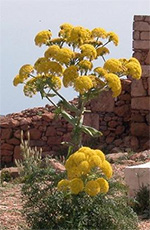
fennel. The shaft of the giant fennel plant formed part of the thyrsus (below).
"fellow . . . fond of gadding up to town, very glib of speech" (p. 425). That little vignette is supposed to evoke the idea of an untrustworthy politician type recommending to the "assembly" of shepherds a disastrous course of action, namely, making war on the maenads to gratify the king.
godhead means "divinity," what makes one a god.
gravid. Pregnant.
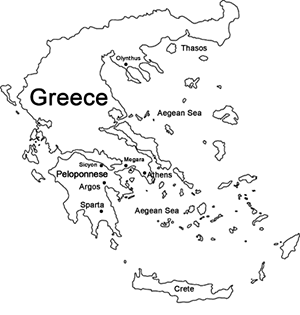
Hellas is another word for Greece, specifically, the homeland of the Greeks in the southern Balkan Peninsula.
Iacchus. "He of the cry 'Io.' " Note that this is a name for Dionysus in Frogs. See Dionysus.
incommunicate. That's Dionysus, disguised as cult leader, speaking to to Pentheus during the interrogation scene. "Incommunicate" translates abakkheutos, which refers to anyone not yet initiated into the the mysteries (the secret aspects) of Dionysus worship.
io bakkhe! Another of the characteristic cries of those worshiping Dionysus.
"jackboots" (p. 422). The Greek, arbulē, refers to some kind of boot. The translation makes you think of Nazis, something Euripides wouldn't have known about. But it somehow seems to fit.
maenad. (Greek mainas, "she who raves/is mad.") Aka bakkhē, bacchant, bacchanal. Female worshiper of Dionysus. Characteristics include: thyrsus; panther skin worn over shoulders; snakes held in hands and/or around head; obliviousness to cold, heat etc.; possession, called enthousiasmos or ekstasis, by the god.
Muses, goddesses of music, dance, poetry, creative endeavor.
Nysa, mythical mountain where Dionysus had his second birth from Zeus' thigh. The mountain's exact location was disputed in antiquity, but is generally understood as lying well to the east of Greece.
Olympus, mountain in northern Greece. Its summit is home of the gods. Olympus sometimes simply means "heaven" as divine dwelling place.
omophagia. "Raw flesh eating." Sometimes attributed to Dionysian worship, it is not clear that this was ever actually done. See also sparagmos.
"oriental ladies" (p. 420). The Roche translation of Euripides, like Fagles' of Sophocles, is by now somewhat dated. "Oriental ladies" is a problematic rendering of what in Greek is barbaroi gunaikes: literally, "barbarian women." I would say that the Greek is already is problematic. The term barbaros conveys the idea of someone who speaks a seemingly incomprehensible language ("bar-bar") and therefore isn't Greek. The non-Greekness, the Otherness, of the Chorus, and the quasi-Otherness of Dionysus himself, matter in this play.
orgia (plural), "orgiastic" (adjective). Not sexual orgies but rites honoring Dionysus, what Dionysus in our translation calls "rituals of possession." Sometimes translated as "bacchanal."
oresibasia. "Mountain dancing." One way for maenads to celebrate the rites Dionysus was for them to head to the mountains unescorted, there to dance the night away in honor of the god. Often, it will have been winter with the snow on the ground. (Winter was Dionysus' special time of year.) But the maenads wouldn't wear special clothing against the cold.
paean. A praise song, a hymn.
Pharos is an island at the entrance to Alexandria's harbor, in Egypt.
Pieria is in a part of northern Greece called Macedonia. It, along with Mount Helicon, was home to the Muses.
porter. Doorman.
roaring god. Bromios, i.e., Dionysus.
Sidon, city in Phoenicia (Lebanon). Cadmus comes from there.
sophistry. Pentheus to Dionysus: "What sophistry! You should be chastened [= punished]." This is a reference to the current scene in 400s-BCE Athens. Sophistry was what the sophists did, namely, teach and practice logical argument and rhetoric. Both of those would have served the needs of aspiring politicians; they came in handy for jury trials. The sophists — "professors" — charged steep fees and were widely mistrusted.
sparagmos. "Tearing of flesh," "dismemberment." In sources, sparagmos is associated with the omophagia, raw eating (which see) of an animal like a fawn or leopard, and supposedly practiced in association with the worship of Dionysus. But it is not clear that this was ever actually done.
purlieu (PERL-yoo). Fancy word for "boundary land" or "vicinity." The "purlieus of Asia" is simply Asia. (Euripides' notion of Asia extends no further than Afghanistan or Iran.)
Rhea ("Mother Rhea). Understand as something like "Mother Earth."
thiasos. Term for a formally organized group of Dionysus' worshipers. or followers — like a congregation.
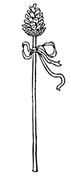
thyrsus. A long stalk of fennel (like a very long and thick celery stalk) topped with bunched ivy, grape leaves, or a pine cone. It was wielded by Dionysus and his worshipers. Mostly carried as a staff in Dionysian processions, in Euripides Bacchae it also serves as a weapon during battle in the mountains. As a weapon, it may not seem like much, but don't forget the transformative power of Dionysus.
Tmolus. Mountain range in Turkey.