
For the rest of the semester (spring, 2020), class will be held online via Zoom. For more on how to prepare, how to connect, etc., consult the "Zoom Meetings" page, this site.
For assignments due 19-Mar through to end of semester, please check Syllabus, Required Texts for alternative (inexpensive and free) editions of required readings.
For the purposes of this syllabus, anytime you see a box like this with light pink background, it means that you're dealing with distance-learning procedures etc. that take precedence over, or that supplement, regular course procedures addressed in the section in which the box appears.
Course Themes
The principal project of the semester will be for each of you, with help from the rest of the class, to formulate the beginnings of a theory of tragedy:
- What is tragedy? Is there a connection between tragic drama and the tragedies of life? Is tragedy always sad?
- Was tragic drama then and there (ancient Athens, ancient Rome) a thing altogether different from tragedy now? Are there connections between, on the one hand, the tragic dramas of the ancient Greeks and Romans, on the other hand, our lives today?
Life is a journey and so is this. I don't expect students to come up with a finalized, polished anything. Rather, I want to see evidence of reflection on the question of what tragedy was then and is now, and an appreciation of the dimensions of the question.
Our exploration will at times be broad and open ended. But we'll also be focusing on two, very specific issues, both with relevance to today's world:
- Gender — how it is dramatized in the plays we'll read and how that might connect with us
- Performance — what we can learn about the plays by thinking of ways to make them more alive for today's audiences. (This is not a theater class, nor will I assign performances of scenes. What we'll do instead is form discussion groups on the day of class to share thoughts about performance and to demonstrate with reading of lines)
- Other people's thoughts — Honig's, Williams', etc. Do they connect with us?
We'll work on the above in our journal entries and in our in-class discussion. It will figure into essay questions on exams.
Student Learning Outcomes
General-Education
This course fulfills the Humanities (H) General-Education requirement for undergraduates taking a degree from Binghamton University. As such, its aims correspond to the following, quoted from the University Bulletin:
"Humanities (H) courses enhance students' understanding of human experience through the study of literature or philosophy."
Course-Specific
By the conclusion of this course, students should expect. . .
- To grasp key facts about ancient practices, cultural realities, etc. pertaining to ancient ancient Greek and Roman drama, especially tragedy.
- To grasp key issues of the modern performance of ancient tragedy.
- To formulate an initial-stage, working theory of tragedy, an answer to the question, "What is tragedy?"
Course Contract
General
By enrolling in this course, students agree to abide by expectations set forth in this and other course-related documents. You should therefore regard any document posted by the instructor to the "Bingweb" site (this site), or to the myCourses site associated with this course, as a contract laying out the responsibilities and expectations instructor and students.
Among the aforementioned are the following:
- Adherence to the the University's standards and regulations regarding academic honesty
- Respectful and courteous treatment of others participating in this class, both while class is in session and between meetings. Avoid, in other words,
- Distractive, discourteous, or disrespectful discussion, commentary, remarks, including offensive (sexually, racially, etc.) or gratuitous speech.
- Disrespecting the personal (i.e., physical) space of others.
- Distractive / disruptive comings and goings (once in class, please try to stay there).
- Distractive use of electronic devices (see below).
- Any activity not directly related to the business of class.
Failure to abide by these expectations may result in appropriate disciplinary action.
Academic Honesty
For the remainder of the semester (14-Mar through final exams), standards of academic honesty will apply just as they did. Only now, it will be easier and more tempting to cheat. Exams will be open-book, but not open-internet. If you copy, paste, and "touch up" someone else's stuff without full acknowledgement of your sources, you are committing plagiarism and risking expulsion from the University.
How to avoid problems? Use only texts and other materials that you are using for class. For this open-book test, it's ok to consult class lectures, study guides, texts etc. available via the Bingweb site (this site) or the myCourses site. Crack open, or consult online, those texts required by me for completion of assignments. (That extends to alternative editions if you weren't able to secure the required edition.)
Do not:
- Go to Wikipedia
- Use other, third-party web sites (Spark notes, etc. etc.)
- Get help from, or consult with, or work in a group with, anyone else on this test (unauthorized collaboration, also an academic-honesty violation)
Please also know that take-home exams will be electronically submitted by Turnitin and that submission will require electronic confirmation of pledge of honesty and originality, and that no one assisted you with your work.
- The University's "Academic Honesty Code" to be found in the University Bulletin under "Academic Policies and Procedures for All Students."
WHAT IS ACADEMIC HONESTY? It is the ability to say that your work is yours, and that you have forthrightly and scrupulously pointed out how you have relied on the words, ideas, research, etc. of others.
As for academic dishonesty, that includes:
- Plagiarism (presenting another's work as one's own through unacknowledged quoting/paraphrasing, use of another's ideas, failure to acknowledge sources, using someone else's research notes or similar)
- Cheating
- copying from. . .
- another's test paper
- a "cheat-sheet" brought to class
- any form of unfair help received
- copying from. . .
- "Recycling" of papers (submitting one paper to more than one class)
- Fabrication (arguing from evidence you've made up)
- Forgery (of signatures, of paper-authorship, etc.)
- Sabotage (undermining efforts of other students)
- Bribery (inducements to affect grade)
- Fabrication of excuses concerning (i.e., lying about) absence, need for make-ups, etc.
Note, too, that any and all instances of academic dishonesty WILL result in a course-grade of F along with appropriate disciplinary action, not excluding expulsion from the University, as deemed appropriate by those authorities charged with handling such cases.
Further, by taking this course, students consent to submit all written assignments to Turnitin.com or other, similar anti-plagiarism databases for textual similarity review. Students also agree not to abet the academic dishonesty of others in connection with this class.
Updating / Modifying Course-Related Pages
The instructor reserves the right to alter, as needed and in reasonable ways, details of the assignment schedule, course syllabus, indeed, any course-related page or document.
Required Texts, Print & Online
Because of the difficulty of obtaining needed editions of texts while class is being held online, I'm going to relax the requirement/recommendation that we all read from the same editions.
If you don't yet have the req'd/recommended editions, here follow alternatives that should work. But the important thing is that you have something to read. The internet is full of translations of these texts; that shouldn't be a huge challenge.
Kindle editions are good because they can be read across a variety of devices.
Here follow my suggestions for free or inexpensive alternatives for texts we haven't yet read:
- The Oedipus plays, translated Storr
- Project Gutenberg
- Kindle (same edition)
- Aristophanes Frogs, Kindle
- Euripides: The Complete Works, Kindle Edition
- Roman Tragedy, Introduction
- Csapo The Context of Ancient Drama pages will be available via myCourses
- For the rest, see the relevant study guide
- Seneca's Complete Tragedies: Agamemnon, Hercules, Hercules Oetaeus I & II, Medea, Oedipus, Phaedra, Phoenissae, Thyestes, and Troades, Kindle Edition
- Anouilh's Antigone, via myCourses
REGARDING REQUIRED TEXTS, we'll all need to work from the same editions.
- We shall be dealing mostly with translations, which can vary widely in quality
- In class and on exams, I shall make reference only to editions listed below
- When we discuss, and experiment with, performance in class, I expect students to have before them assigned texts
Texts for Purchase from Campus B&N Bookstore:
Aeschylus. The Oresteia. Trans. Robert Fagles. Harmondsworth, England and New York: Penguin Books, 1984.
---. Persians. Trans. Janet Lembke and C. J. Herington. Greek Tragedy in New Translations. New York: Oxford University Press, 1981.
Aristophanes. Frogs. Trans. Jeffrey Henderson. Newburyport, Mass.: Focus Publishing, 2008.
Csapo, Eric, and William J. Slater. The Context of Ancient Drama. Ann Arbor: University of Michigan Press, 1995.
Euripides. 10 Plays. Trans. Paul Roche. New York: Signet Classic, 1998.
Seneca, Lucius Annaeus. Four Tragedies and Octavia. Trans. E. F. Watling. Penguin Classics. 2 ed. Baltimore: Penguin Books, 1966.
Sophocles. The Three Theban Plays. Trans. Robert Fagles. Penguin Classics. New York: Penguin Books, 1984.
Electronic Texts via myCourses
Additional readings online are to be accessed via myCourses > Course Documents.
Anouilh, Jean. Antigone. Trans. Barbara Bray. Plays: One. Variation: Methuen World Classics. London: Methuen, 1997. 77-137.
Warmington, E. H. Remains of Old Latin II. Livius Andronicus, Naevius, Pacuvius and Accius. Loeb Classical Library. Cambridge, Mass.: Harvard University Press, 1967. Loeb Classical Library.
Electronic Text via BU Library
Honig, Bonnie. "Introduction." Antigone, Interrupted. New York: Cambridge University Press, 2013. Log-in required.
Access to Online Course Materials / Dual Web Sites
This course employs two, separate web sites:
- A "Bingweb" web site (where this syllabus resides), and,
- A myCourses course site.
The "Bingweb" web site will provide access to course-related information and materials of a non-secure nature, including:
- Syllabus (this document)
- Assignment schedule
- Study guides
- Lectures / instructor's PowerPoints
- Various other informational pages
The myCourses course site is mostly for materials and links OF A SECURE NATURE, things that should NOT be accessible to the general public via internet or Google.
Navigate to the myCourses site via the following "breadcrumb" path:
myCourses > Ancient Tragedy, Greek & Roman
On that myCourses site, you'll find links to:
- Announcements
- Journals
- etc.
E-mail Contact
All students taking this course must agree to check their respective BU E-mail addresses (username@binghamton.edu) on a regular basis, as that will be the principal medium for instructor-student communication outside class.
My E-mail is ascholtz@binghamton.edu. For my office hours, schedule, etc., visit the "Contact" page.
Attendance, Absence, Tardiness
Attendance is required, as is prompt arrival at class; learning cannot happen if we are not there on time and participating. Attendance will be taken and will figure into the participation grade. Students missing 7 or more classes risk not receiving a passing grade. A pattern of tardiness can and will count as absence(s) at the discretion of the instructor.
To leave class early unexcused will count as absence; any graded exercise due that day in class will count as zero. (Don't leave after quizzes!)
Excusable Absence
IF YOU ARE ILL, or otherwise cannot make class, or expect not to be able to make a given class or classes, for VALID REASONS (religious observance, job interview, important family function, etc.), please contact me AS SOON AS POSSIBLE via E-mail. Without timely E-mail notification, I will not credit missed classes, nor will I reschedule planned in-class exercises, i.e., quizzes or the like.
IN OTHER WORDS, it is the absent student's responsibility to arrange for timely make-ups — by "timely," I mean IMMEDIATE. I do not reschedule merely to accommodate "busy" schedules, as that would be deeply unfair to others just as busy.
- To be able to make up any graded in-class exercise (quizzes, exams), I will need a valid and signed physician's note or equivalent. Please do not, however, "double schedule" interviews, appointments, etc. for class-time.
Think of it this way: Excusably absent from class Thursday, makeup Friday or Monday. Tuesday ordinarily too late.
Non-Excusable Absence
The following, quoted from the University Bulletin (Academic Policies and Procedures — All Students > Attendance in Classes), applies to this course: ". . . instructors have the right to deny a student the privilege of taking the final examination or of receiving credit for the course, or may prescribe other academic penalties if the student misses more than 25 percent of the total class sessions. Excessive tardiness may count as absence."
Put differently, excessive absence and/or excessive lateness may result in a grade of F.
Non-excusable absence includes:
- Oversleeping / alarm-clock malfunction
- Absentmindedness (keep track of class and assignment schedules)
- Long-weekends, vacation "extenders," plane reservations
- Unexcused early departure from class-meeting (counts as absence)
For more on attendance, see the University Bulletin.
Required Absence Due to Illness
If you are clearly and obviously sick enough that it interferes with your learning, obviously, stay home and get better; maybe see a doctor. Do not come to class. That is for your sake but it is also to prevent you from infecting others.
In-Class Use of Electronic Devices
I do permit use of electronic devices in class by students. That includes use of laptops, tablets, cellphones (aka mobile phones).
Students who abuse the use of devices, i.e., who use them for purposes extraneous to class, may have the privilege revoked, temporarily or permanently.
Without instructor's permission,* audio-recording of lectures or other in-class activities is forbidden. Unauthorized sharing of recorded classes, lectures, etc. by students is a violation of property-rights law and as such is subject to academic and/or legal sanction. All video recording is forbidden, without exception.
* Students with the proper documentation from Services for Students with Disabilities need to make known to me their need to use voice recording — see more, below.
Bootlegged Notes
By "bootlegged notes" I mean a set of practices expressly forbidden for this class, any one of which could result in a failing grade:
- Unauthorized note-taking, i.e., arranging to have someone extraneous to the class attend to take notes
- Unauthorized distribution of notes
- For this last I don't mean the occasional sharing of notes with friends unable to make a given class meeting — not forbidden, but don't make a habit of it. I mean note-sharing as a service or a regular practice, whether one does it for money or not.
Students with Special Needs
Students with special needs are strongly encouraged to contact me in addition to contacting the office for Services for Students with Disabilities here on campus. Those needs can include, but are not confined to, extra time on exams, the need to record lectures and classroom activities, the need for a note-taker, and so on. It will be necessary for students to obtain and to pass on to me the proper paperwork for such accommodations (for which, check in with Services for Students with Disabilities).
Assessment of Student Work (grading)
Weighting
| 20% | |
| Journals | 20% |
| quizzes (2) | 10% |
| midterm exam | 20% |
| final exam | 30% |
Grading Scale
| A | 93-100 |
| A- | 90-92.9 |
| B+ | 87-89.9 |
| B | 83-86.9 |
| B- | 80-82.9 |
| C+ | 77-89.9 |
| C | 73-86.9 |
| C- | 70-82.9 |
| D | 60-69.9 |
| F | 0-59.9 |
Participation, Reading, Preparation, etc.
General
Assigned readings, associated journal entries, indeed, anything assigned for this class must be done, and on time, which is to say, by class on the date indicated on the assignment schedule. Failure on that score will compromise one's grade.
Discussion will be partly structured, partly unstructured, and will center mostly on issues and topics listed on the schedule of assignments and on study guides.
- INSTRUCTOR'S CALLING ON STUDENTS
- RESPECT FOR ONE'S OWN AND OTHERS' THOUGHTS
Discussion cannot happen if we don't acknowledge that not all contributions will represent the most profound of insights. Please do not, therefore, feel reluctant to participate simply because you don't have anything remarkable to say. Life is a journey and all discussion is dialogue, a dynamic process requiring your input.
Don't be surprised if I call on you in class. I do this a lot; it actually works well — shy students don't feel reluctant to speak when asked to comment in that way. It does, however, mean you'll need to prepare.
Study Guides
You should understand study guides as assigned reading along with the plays etc. themselves.
- Designed to be user-friendly, especially for those new to the study of "classical antiquity" (ancient Greece and Rome), study guides introduce readings and related material, including background (historical, etc.) crucial to make sense of it all
- Study guides clue you in to important topics for discussion in class, journal entries, etc.
Study guides can be accessed via the "Assignments" page next to each reading assignment. Plus, there is a section devoted to them on the Site Index.
Online Journals, aka Reader Response Journals
As indicated on the Assignments page, prior to certain classes (not every class), students will be assigned journal entries of between 300 and 400 words, an entry based on the journal entry prompt for that day's class, found on the Study Guide assigned for that day's class. Journal are to be completed online via myCourses (see below).
- These journals are private Only you and the instructor can see what you write.
Entries shorter than 200 words I will not accept. Entries longer than 400 words I may read only in part. Do not upload a word doc or similar for this, as I will not read or accept it.
Do this no later than the morning of class. Please note that this is required, is graded, and counts toward 20% percent of the grade.
Grading Rubric
Note that each journal entry will be graded according to the following rubric:
100. Entry reflects that student has done and has thought about assigned reading and about the journal prompt. Student has written enough to satisfy requirement (see above).
- There are no right or wrong answers; I'm looking for a good-faith effort. These won't be graded with the expectations of a paper, but please aim for correct spelling, grammar, coherence, relevance. Don't be afraid to speak your mind, or to suggest topics to discuss or to clarify in class.
75. Equals "OK," but no more. An adequate effort has been made, but not enough to merit full credit.
0. Either no entry or the entry falls significantly short of expectations.
How-To of Journals
To complete an entry for a given assignment, look on myCourses for the specific link under:
myCourses > Ancient Tragedy, Greek & Roman > Reader Response Journals
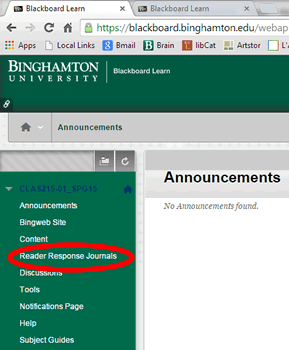
Click that link.
You will then see another "Journals" link appear just to the right. Click it. Give it time to load.
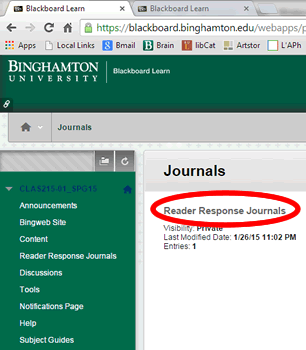
When the following screen appears, read the "Journal Instructions," then click the "Create Journal Entry" link as indicated below (red circle):
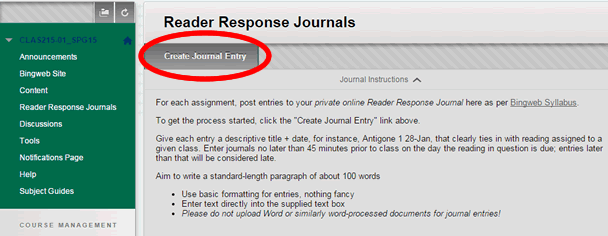
Enter your journal entry as per those instructions.
Quizzes
There will be TWO, FACT-BASED QUIZZES — multiple choice IDs dealing with readings and lecture / discussion: titles of readings, authors' names, relevant terms. For instance:
In Aeschylus' Agamemnon, what is the name of Agamemnon's wife? Is it:
Of course, the answer is c., "Clytemnestra."
- Cassandra?
- Iphigenia?
- Clytemnestra?
- None of the above?
The purpose of these will be to encourage you to keep up with the material. No essays, no interpretation.
Note that in studying for quizzes, the terms page will be of great use, as will lecture PowerPoints and study guides, not to mention your notes on readings.
Quizzes are important, a full letter's-worth of grade (10%). Take good notes, pay attention in class, keep track of basic text facts as appropriate — authors, titles, approximate dates, situations, subject matter, main characters, etc. I do not quiz for obscure details, precise dates, or the like.
Exams
Tests/exams will be take-home, open-book affairs, slightly modified versions of the tests described on the midterm/final study guides, though with the usual sorts of questions. Only instead of writing in a blue book, you will type a word doc (or noodle doc saved as a word doc) for your answers. You will then upload that doc via the myCourses > Turnitin link. It will not be due on the same day as the test paper (with my questions) is published. You'll have time to get it done.
Standards of academic honesty will be rigorously applied; see above.
There will be two exams: a midterm (20% of grade) and a final (30%).
Midterm
- A more detailed guide to the midterm can be found here.
To sum up, the midterm will involve:
- Multiple-choice questions focused, as per quizzes, on factual matters
- Short-answer questions requiring paragraph-length answers combining
- Factual elements ("Explain what an ekkuklēma was, . . .")
- Interpretive elements showing that you can process facts in relation to key questions explored in class (". . . then talk about how its use might have related to the dramatic arc of a tragic play's plot in classical Athens?")
- Some short answers will require that you comment knowledgeably on quotations from readings, so be prepared!
Same recommendations (above, quizzes) regarding studying: review texts, notes, study guides, terms, PPTs.
Final Exam
- Final Exam Study Guide, with specifics on the "how" and the "when" of the test.
The Final exam will be exactly like the midterm in that it will have:
- Multiple choice questions
- Short answer questions
But it will also have a longer essay to help you synthesize what you'll have learned.
It will help that I provide the text of that essay question right here:
"In drama you struggle, because you hope you’re going to survive. It’s utilitarian – sordid. But tragedy is gratuitous. Pointless, irremediable. Fit for a king!" (Chorus in Anouilh's Antigone, p. 102).
What do you think the Chorus means by that? Do you agree? Disagree? Judging by dramas read during both halves of the semester (please discuss at least two from each half), how does this quote validate or challenge your definition of tragedy? How do you respond?
I will not allow make-ups of exams except in cases of verifiable illness, etc.; see above for more information.