Journal Prompt: Is Roman Tragedy Tragic? (part 1)
What do you think Brill's means when it says that "the content of Roman tragedy is not 'tragic.' "? What, according to Brill's, is untragic about it? What assumptions seem to lie behind Brill's generalization?
Text Access, What to Read
Print Text:
Csapo The Context of Ancient Drama pages. . .
- 207-210
- 275
- 306-7 (top)
- 312-320 (top)
Online Reading
Zimmermann, Bernhard (Freiburg), and Baier, Thomas. "Tragedy." Brill’s New Pauly. Ed. Hubert Cancik and et al. Brill Reference Online. Web. 16 Jan. 2020. [link to reading, PODS login required. Multiple clicks/taps may be needed to get the link to work]
- Read only "II. Roman," about ½-way down web page. Please note technical terms used there: crepidata (plural crepidatae), praetexta (plural praetextae). Discussion of authors Livius Andronicus, Naevius, Ennius, Accius, Pacuvius, Seneca. Greek mythological (crepidatae), Roman historical (praetextae) subjects. Roman political and (Seneca) philosophical themes and subtexts. GLOSSARY: res publica, the Roman "state"; Punic Wars, wars between Rome and the North African city of Carthage; ludi, Latin word for a Roman dramatic-religious festival; "aetiological references," references to mythological explanations for the origins of cities, peoples, etc.; senatus consultum de Bacchanalibus, Roman anti-Dionysus legislation (186 BCE); populus romanus, the "Roman people."
In class — thus not for homework — we'll work on a few of the fragmentary remains of Republican drama: PDF Xerox, "Early Roman Tragedy." HOWEVER, passages discussed in class (see relevant PowerPoint) will figure on final exam. (You can find the PDF on myCourses course site > Content.)
Introduction to Rome
Historical


First, these are Romans, not Greeks. Their language was Latin (a language of Italy, and ancestor of French, Spanish, Italian, etc.), though educated Romans also knew Greek. Their knowledge of Greek was naturally aided by the Roman conquest of Greek-speaking territories (southern Italy, Greece proper) in the third and second centuries BCE. The gradual Hellenization ("Greekification") of the Romans is a noticeable phenomenon; compare the spread of Chinese culture to Japan, Korea, and Vietnam.
Initially, Rome controlled only itself and its surrounding territory, a very small corner of central-western Italy called Latium. Eventually, though, its empire grew to encompass virtually the entire world known to Mediterranean peoples. From Portugal to the Persian Gulf, from Scotland to Egypt, Roman law and culture (and, to a certain degree, the Latin language, especially in the west) came to be the (nearly) universal standard. All roads led to Rome, and by 212 CE, all free men and women residing within the empire were Roman citizens.
But periodicity needs to be kept in mind . . .
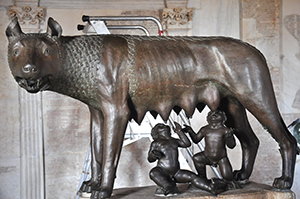
- MONARCHIAL PERIOD: From the founding of the city (traditionally, 753 BCE) until about 512, Rome was ruled by kings
- REPUBLICAN PERIOD: From about 512 until 44 BCE (the death of Julius Caesar), Rome was a republic (i.e., non-monarchy) of a basically oligarchic cast (rule by the elite few). The Senate (senatus, "council of elders") and elected officials ("magistrates") administered the state; the People (populus) elected those officials and passed laws
- PRINCIPATE: After a period of civil war and unsettled politics, a kind monarchy was imposed, with an emperor (princeps, imperator, Caesar, Augustus) ruling in (theoretical) cooperation with the Senate. This lasted from about 27 BCE until the later third century CE
Literary
The Romans at first seem not to have had their own literature. But contact with, and then conquest of, Greek speaking lands rapidly spurred interest in Greek language, culture, and literature. Or as Horace in one of your readings puts it, "Greece, now captive, took captive its wild conqueror, and introduced the arts to rural Latium."
The first Roman author to write in Latin was originally no Roman at all but probably a Greek who ended up in Rome, one Livius Andronicus. (Livius is a Roman name he'll have got from a Roman patron; Andronicus is his original Greek name.)
Livius Andronicus illustrates a pattern that, to one extent or another, underlies nearly all Roman Latin literature: that of adaptation of, or inspiration by, Greek originals. Thus Livius wrote the first Latin epic poem, the Odyssia, a translation-adaptation of Homer's Odyssey.
Livius also wrote dramas, tragedies and comedies, that are also adaptations from the Greek.
Successors to Livius (native Italians) kept up the pattern. Among those you'll be looking at Naevius and Accius. But even Seneca operates well within the parameters of Greek mythology.
STILL, however much the Romans adapted from the Greek, they made it all theirs. Their literature became then, right from the start, a vehicle for expressing Roman values and ideas: of virtue (virtus); of loyalty to family, friends, country (fidelitas, pietas); of law and order (iustitia, ordo).
How do you see that reflected in the works we'll read?
Roman Tragedy
Study this section of study guide, but we'll look at textual fragments in class.
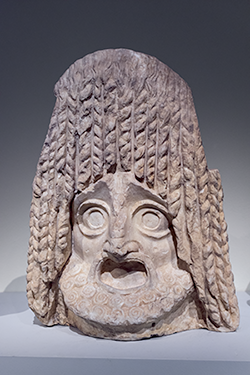
We'll talk more in class about qualitative differences between Roman and Greek tragedy; here I provide a very sketchy intro to Roman examples of same.
Roman tragedy came in two, basic varieties:
FABULA CREPIDATA, or "play wearing the Greek boot," i.e., employing plots from Greek myth and perhaps adapting a Greek original.
FABULA PRAETEXTA, or "play wearing the fringed toga of a Roman high official," i.e., taking its plot from Roman history, whether remote or recent.
In the early period, by which I mean the Republican period (512-44 BCE), drama, including tragedy, was typically staged by wealthy officials for the enjoyment of the Roman populace at important religious festivals, though not the Dionysia, which held no official standing in Rome. It was NOT staged to compete, nor did Romans produce tetralogies, but individual plays. These earlier playwrights were often themselves of non-Roman origin and were attached to important Romans as patrons. This is very different from the situation in 400s and 300s Greece.
Comments on Roman Tragic Fragments ("Early Roman Tragedy," in Remains of Old Latin 2)
Naevius Clastidium
Your Naevius (ca. 265-190 BCE) reading consists of no more than a single line from a lost play, the Clastidium (performed 195 BCE?), which described the victory in single combat of the Consul (high Roman official) Marcus Claudius Marcellus over the Gallic chieftain, Viridomarus, in 222 BCE. In reward, Marcellus received the spolia opima.
This play illustrates fabula praetexta, a play on a Roman historical subject — here, very recent history. Naevius also wrote crepidatae (tragedies adapted from the Greek), comedies, epic, and satires.
Accius
Accius (170-ca. 95 BCE) provides our richest source of tragedy (none complete) from the Roman Republican period. Above all, he took Euripides as his model, though also Sophocles and Aeschylus. The ancients pronounced him a disertissimus poeta, a "poet of the highest eloquence." Do you, then, seem to detect a rhetorical element in what remains of his stuff?
Accius: Atreus
Much of the Accius material you'll read comes from his Atreus, the basic outlines to which story you'll find under the Oresteia study guide ("Feast of Thyestes"). That will, of course, be a fabula crepidata, a play on a subject drawn from Greek myth.
- NOTE THAT from Accius' Atreus comes a line, "Let them hate so long as they fear!" (frag. 168, p. 383), that seems to have inspired entire passages of Seneca's Thyestes, based on the same myth, and Pseudo-Seneca's Octavia, which, like Accius' Atreus and Seneca's Thyestes, treats the theme of the tyrant and his anger. HOW, THEN, DO THESE ROMAN TREATMENTS OF TYRANNY (that includes the other plays that we'll soon be reading) DIFFER FROM THAT OF A GREEK PLAY LIKE SOPHOCLES' OEDIPUS THE KING?
Accius: Brutus
This is a praetexta, a play on a Roman historical subject, here, the Rape of Lucretia, a likely legendary event from Rome's early history, with tragic resonances and political implications, as it precipitated the revolution leading to the overthrow of the Roman kings and their replacement by a republic.
The story itself is hopelessly complicated, with multiple persons related to one another and even carrying the same name. Ahem. . . .
- Tarquin the Proud, king of Rome, is fighting a war, but is made to worry that he'll lose power
- His sons (all Tarquins), plus his nephew Tarquin Collatinus, wonder if their wives back home are being faithful, so they go check
- Sextus Tarquin (the king's son), accompanying Tarquin Collatinus, conceives a fierce passion for his cousin's wife (Lucretia) and rapes her
- Lucius Junius Brutus (another nephew of the king), who up to this point had been playing the part of a speechless simpleton (Brutus means "brute" or "mute"), along with Tarq. Collatinus and and Publius Valerius, hear of the rape and visit Lucretia
- She kills herself in their presence, thereby demonstrating her virtue
- But her last wish is that her husband and friends avenge her
- After overthrowing the arrogant king Tarquin, Brutus and Collatinus become the first consuls of Rome