Text Access
Pseudo-Seneca. Octavia. Trans. E. F. Watling. Seneca. Four Tragedies and Octavia. 2 ed. Penguin Classics. Baltimore: Penguin Books, 1966. 255-96. (Available via bookstore.)
Date, Author, Genre
The play was NOT composed by the philosopher-tragedian-courtier Seneca — hence "Pseudo-Seneca" for author, though that would better read "anonymous." (The play comes to us in manuscripts containing Seneca.) The play clearly postdates Seneca (died 65 CE), perhaps by as much as thirty years (see arguments in Ferri's 2003 commentary). But its author, who clearly knew his Seneca, must forever remain unknown.
As to genre, at a certain, fairly superficial level, we needn't worry. For purposes of classification, it is an example — the only complete example to survive — of a praetexta, a play on a Roman historical/legendary topic. Yet note the frequent attempts to connect the action, mood, etc. of the play to Greek mythology — what's that all about?
Background
The following supplements the more or less decent background supplied by the Penguin translator.
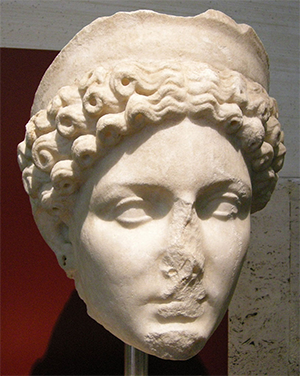
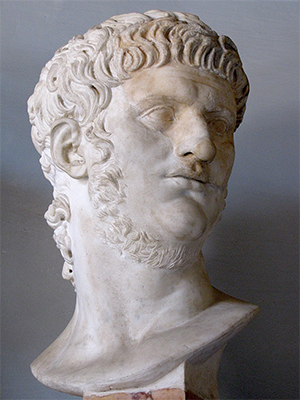
The events of the play take place over the course of three days early in 62 CE, in the course of which Nero will divorce his current wife and stepsister, Octavia, to marry his girlfriend, Poppaea. The following deliniates not just the play's action, but relevant prequel and sequel events:
- Octavia (ca. 40 CE-62), daughter of the emperor Claudius (r. 41-54) and Messalina, originally will have been named CLAUDIA, after her father
- Agrippina, Claudius' second wife, persuades her new husband to adopt her son, Nero, and to favor Nero over Claudius' natural son, Brittanicus, as heir apparent
- That makes Claudius' daughter "Claudia" and Nero stepsiblings
- Agrippina also engineers a marriage between Nero and this same daughter of Claudius. But for that to happen, "Claudia" has to be adopted into another family — in this case, that of the Octavii — in order for the marriage not to violate laws against incest. So "Claudia" becomes an OCTAVIA prior to her marriage to Nero
- In 54/5, soon after Nero's accession to the emperorship, Octavia's brother Brittanicus, because a competitor for the throne (he is Claudius' natural son, whereas Nero was adopted), is poisoned by Nero
- That marriage finally happens in 53. But Nero soon finds two other women, the ex-slave Claudia Acte, and the noble woman Poppaea Sabina, more attractive. See further below for Poppaea's marital history. . .
- In 59, Nero arranges for Agrippina, his mother, with whom he has been competing for power, to be killed (see further below)
- Nero, claiming that Octavia is (a) barren, and (b) unfaithful, and (we think) probably connecting her (supposed) infidelity to (supposed) plots by his enemies, in 62, banishes Octavia to an island where she is executed
Note that prior historical examples figure into the drama's allusive texture:
- Lucretia (see Accius' Brutus study guide)
- Agrippina, whose killing by Nero, her son, is treated as a precedent for Nero's treatment of Octavia
So political themes are prominent, particular those of tyranny. Compare, then, Nero in this play with Atreus in Seneca's Thyestes or with Creon in Sophocles' Antigone. Similarities? Differences?
Notes
257. "vile stepmother's." Refers to Agrippina, Octavia's stepmother, but also her mother-in-law (mother-in-law because Agrippina married Claudius, Octavia's father, after the death of Messalina, Octavia's biological father).
261. "a ship of death." Nero had a death yacht built to kill his mother, Agrippina. I.e., it was designed to sink and drown her. But Agrippina swam to shore and made it back to her sea-side villa. She eventually had to be slain by a soldier.
- Read the historians Tacitus and Suetonius on the death of Agrippina.
261. "that unlawful lamentable marriage." Claudius, in marrying Agrippina, married his own niece.
263. "the likeness of the winged God himself." The Nurse means that Brittanicus, Octavia's full brother murdered by Nero, possessed the beauty of Cupid/Amor (= Greek Eros), god of love.
264. "the Queen of goddesses herself" etc. The Nurse compares Octavia to Juno (in Greek, Hera), queen of the gods and wife of Jupiter (in Greek, Zeus). Jupiter-Zeus, taking on a variety of disguises (swan, bull, etc.) to seduce or rape young women, was notoriously unfaithful as a husband. Note, too, that those two gods (Juna and Jupiter) were siblings, just as Octavia and Nero are step siblings.
265. Alcides. Alcides i another name for Hercules (as Heracles was known in Latin).
266. "False Nero ... Domitius' son ... Augustus." Nero's birth name was Lucius Domitius Ahenobarbus. On being adopted by his stepfather, the emperor Claudius, the boy became Nero Claudius Caesar Drusus Germanicus, or "Nero" for short. The name "Augustus," an imperial title, Nero will have gained as a consequence of his becoming emperor in 54.
270. Acheron. Like the Styx, a river in the Underworld.
271 ff. Seneca the character here evokes associations with the Stoic concept of empyrosis, the idea that the world will someday end in a vast conflagration, out of which will be born a new world. That would make sense, as Seneca was a noted Stoic. This rebirth of the world then leads to the notion of a new Golden Age, then to a fairly conventional account of the decline of human beings from the original Golden Age to a decadent present — a frequent topic in Roman literature, and one drawn from Greek.
275. Pater patriae. An honorary title: "Father of his Country."
276. Brutus. This is Marcus Junius Brutus who, in 45 BCE, led the plot to assassinate Julius Caesar on the Ides of March (15-Mar) of that year. He is, therefore, hailed here as a tyrant-killer. (That's different from Lucius Junius Brutus, founder of the Republic, and hero of Accius' Brutus. The later Brutus did, though, claim descent from the earlier one.)
276 f. "Roman blood" etc. etc. This passage refers to civil wars that spread through much of Italy and the Roman empire following the death of Julius Caesar in 45 BCE.
277. "two leaders." Marc Antony and Octavian, the latter being the future Augustus. From 36 BCE to 31, the Roman Empire was effectively split in two, with the west under Octavian's command, and the east under Antony's; Antony had meanwhile taken up with Cleopatra, queen of Egypt. Octavian defeated Antony and Cleopatra at the Battle of Actium (31 BCE), after which the lovers fled to Egypt, where they killed themselves in 30 BC.
286. Crispinus. That's Poppaea's first husband, Rufrius Crispinus, whom Poppaea divorced to marry Otho, the future emperor, in 58. But in the same year, she entered into a love affair with Nero and married him. Poppaea died pregnant in 65. (The story that she died from Nero's kicking her in the stomach is probably a fabrication.)
286. "Your second husband's arms." The translator means Nero. But the Latin says not "second," but "new" (novi). Nero was in fact Poppaea's third husband.
287. "Jove the Thunderer." That's Jupiter (in Greek, Zeus), whose name in English is also often given also as "Jove."
287. "Let Sparta praise her daughter's beauty." This "daughter" of the city of Sparta is, of course, Helen.
292. "mother of the Gracchi." The Gracchi's mother was Cornelia (ca. 190 BCE-ca. 176/5), an exemplar of old Republican virtue. The Gracchi brothers both died struggling for Roman liberty against aristocratic foes.
293. Ship. Octavia imagines that Nero wants to do with her as he did with his mother: put her on a sabotaged ship for the purpose of drowning her.
294. "women of your name." The chorus means "of your extended family," since "Octavia" wasn't Octavia's original name.
Quiz 2 Study Guide
On T, 27-Nov, there will be a VERY SHORT QUIZ of material covered in class assignments and lectures 26-Oct (yes, Williams Modern Tragedy WILL be on the quiz) through and including 14-Nov (Aristophanes' Frogs).
- In order to have at least some new material to test you on for the final, the Roman material won't figure on this. So, a great chance to review!!
It will be very short, plain, non-interpretive, and straightforward — a "fact-check" quiz more than anything else to encourage attentive reading and in-class listening.
It will also be MULTIPLE CHOICE, including a "none of the above" choice for each question.
Specifically, expect:
- Multiple choice questions targeting. . .
- Class-assigned readings, for which know. . .
- authors (where appropriate, you won't have authors' names for everything)
- titles (where appropriate, you won't have titles for everything)
- characters, key actors/speakers (where appropriate)
- basic and crucial content info
- key terms and concepts listed below, for which consult
- your notes
- our target texts
- my PowerPoints
- Terms page
Review Terms List. (For definitions, see "Terms")
Much abbreviated this time:
- parody, parodic, paratragedy, paratragic
- satyr
- silen, silenos, Papposilenos